


Rural banking exams are one of the most sought-after career options for many aspirants like you who are interested in contributing to rural development. Many aspirants are eagerly writing for the RRB PO, RRB Clerk, and NABARD Grade A notification.
Unfortunately, many aspirants make the same common mistakes in their preparation and while attempting the exam, which cost them their year.
In this article, I’ll explain the most common mistakes many aspirants make in rural banking exams and how you can avoid making them. So instead of making your own mistakes, you can actually learn from the mistakes of other aspirants.
Why Do These Mistakes Matter?
Rural banking exams, such as NABARD Grade A, RRB PO, RRB Clerk, and other similar exams, require a specific approach, as the requirements of these positions differ.
Many rural banking exams cover the same subjects and similar subjects. But still, many aspirants failed to crack these exams as they made the same mistakes in every attempt.
If you are an aspirant aiming to crack these exams, you’ve likely come across numerous preparation strategies. But sometimes making small mistakes can cost you your precious chances.
So, let’s dive into the most common mistakes and how to avoid them.

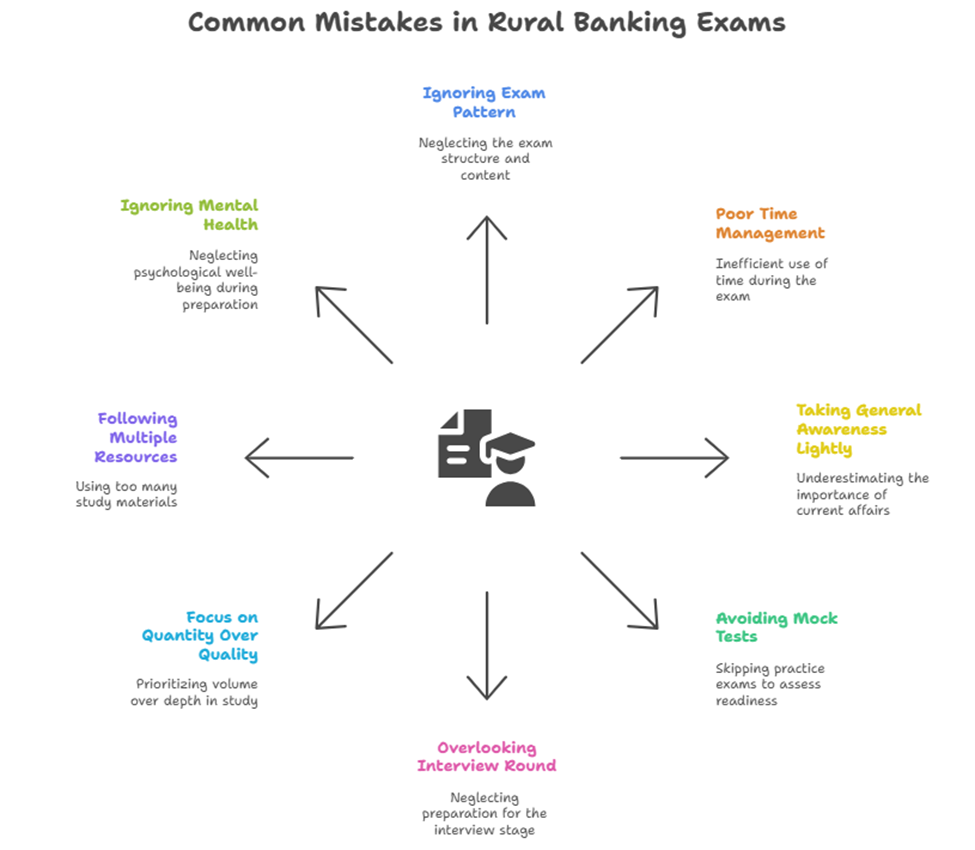
Mistake 1: Ignoring the Exam Pattern and Syllabus
One of the first mistakes many aspirants make is to take just an overview of the exam pattern and syllabus. You must know that each rural banking exam has slight variations in terms of:
- Number of subjects
- Types of questions
- Weightage/mark distribution
If you don’t align your study plan with the official rural banking exams pattern and syllabus, you’ll waste your time on irrelevant topics.
How to Avoid This Mistake:
- Read the official exam notification carefully to deeply understand the latest syllabus and exam pattern.
- Also, check if there is any change to the pattern and syllabus as compared to the past year’s notification.
- Check out the past years’ papers to identify the high-weightage topics and focus on them.
Mistake 2: Optimizing Time Management Poorly
Poor time management is one of the most common mistakes that many aspirants unintentionally make. They fail to manage their time well during their preparation, which continues in the final exam.
You need to understand that you have limited time for preparation, and the actual exam is also time-bound. So, managing your time poorly can lead to incomplete attempts or rushing through questions, both will impact your scores.
How to Avoid This Mistake:
- Create a practical study timetable that you can actually follow.
- Carefully divide time between subjects based on their weightage.
- Practice time-bound mock tests to get a feel of the exam pressure.
- Learn which questions you can attempt and which ones you should leave or keep for the end.
Mistake 3: Taking General Awareness Lightly
General Awareness is a crucial subject in any competitive rural banking exam. But many, many aspirants underestimate the actual importance of GA and take it lightly.
You need to know that GA covers a wide range of topics, including financial and banking current affairs, reports, national & international news, government schemes, and many more.
However, GA is one of the most scoring subjects. It requires less time to solve questions as compared to quant and reasoning questions, as there are no complex formulas and tricks required.
Skipping this crucial section or studying it casually can cost you a lot of marks.
How to Avoid Overlooking GA:
- Daily read newspapers and magazines to stay updated with national and international current events of the banking and economic sectors.
- Focus on important banking terminology and government schemes in the news.
- Make small GA notes and revise them daily, as GA is all about retention.
Mistake 4: Avoiding Mock Tests
Many aspirants often undervalue the actual importance of practicing mock tests. You must understand that studying concepts is important, but practicing questions based on those concepts is also crucial. It helps you understand whether you have fully understood those concepts or not.
Moreover, mock tests help you get familiar with the actual exam pattern, find high-weightage topics, and identify your strong and weak areas.
How to Avoid This Mistake:
- Solve at least 1-2 mock tests every week.
- Always practice time-bound mock tests.
- Take time to analyze your mistakes and revisit the concepts of your weak topics.
Mistake 5: Overlooking the Interview Round
Your exam doesn’t end with the written test. Most of the officer-level rural banking exams include an interview after written tests. Many aspirants only focus on the prelims and mains subjects and keep the interview for the end.
How to Avoid This Mistake:
- Do not keep the interview for the end, and prepare it along with your written exams.
- Stay updated on banking and finance current affairs.
- Prepare for biodata carefully, as most of the questions will be asked from your biodata.
- Work on your communication skills.
Mistake 6: Focusing on Quantity Over Quality
In quantitative aptitude and reasoning ability subjects, many aspirants try to solve as many questions as possible, but they don’t focus on their accuracy.
Cracking a competitive rural banking exam requires both quality and quantity. So, you should aim to attempt enough questions with high accuracy to clear the cut-offs.
How to Avoid Making this Mistake:
- Learn all the basic formulas of quant and reasoning.
- Focus on understanding the core concepts rather than just checking the solution of every question.
- Avoid making guesswork; they don’t usually work.
- You’ll end up losing more marks in negative marking.
Mistake 7: Following Multiple Resources
Many aspirants make the mistake of collecting multiple resources, which later confuses them. You need to understand that having too many resources makes it difficult to focus on one good source, as multiple sources offer multiple ways to solve a question, confusing you even more.
How to Avoid This Mistake:
- Stick to 1 or 2 (Max) recommended resources for each subject.
- Use reliable online platforms or apps.
- Review PYQs to know high-weightage topics.
Mistake 8: Ignoring Mental Health
Competitive exam preparation can be stressful. Many aspirants only focus on studying and neglect their mental health. As a result, they are more likely to feel stress and anxiety, especially on exam day.
How to take care of your health:

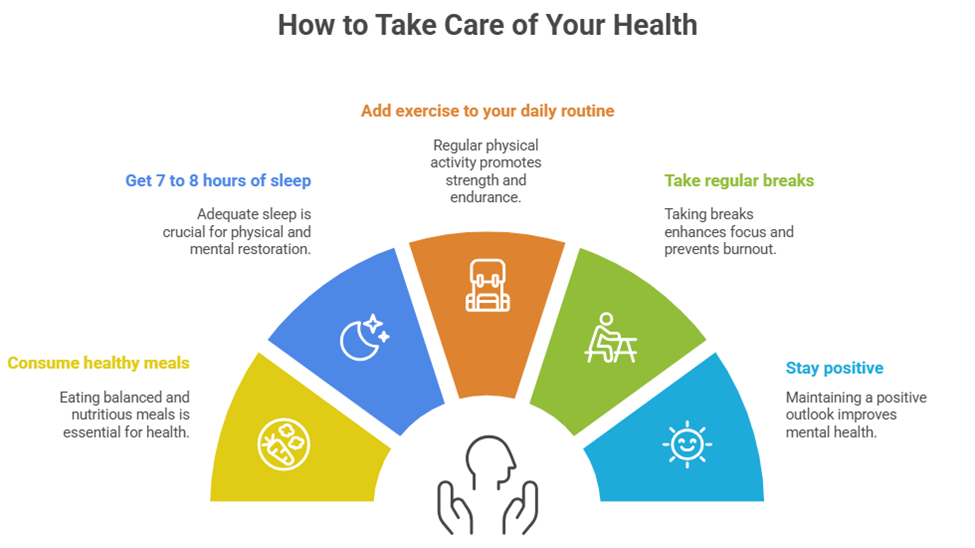
- Consume healthy meals
- Getting 7 to 8 hours of sleep helps you retain information.
- Include exercise in your daily routine
- Take regular breaks during study sessions.
- Stay positive
Conclusion: What’s Next?
By avoiding these common mistakes, you can significantly improve your chances of cracking the competitive rural banking exams.
You should start your preparation by understanding the exam pattern and syllabus, managing your time wisely, practicing regularly with mock tests, staying updated on GA topics, and focusing on quality over quantity.
Lastly, don’t forget to take care of your mental as well as physical health during the preparation.